

How To Stop Trying To Fix Everything At Once
We’ve all been there.
We hit a point where things become painful. Something isn’t working, or maybe multiple things aren’t working, and we want or need to change. We put on our favorite jeans and they don’t fit, or we get passed over for another promotion, or something happens with our partners or kids, and we reach that point Tony Robbins calls “threshold”--the point where we just can’t tolerate it anymore. We vow to change, and then set Olympics-level goals at 10:00 pm on a Tuesday.
There is something there that’s powerful. To set goals that work, we have to be motivated to meet them, and that breaking point can be pivotal.
But when we set goals from that emotional place, we often set too many at once, or try to make massive, sweeping changes without a structured plan. And there are steps to take that make goals stick long-term, not just for the next couple of days or weeks, that we don’t typically don’t plan for at that breaking-point moment.
Don’t get me wrong–making large-scale changes across many areas of your life at the same is possible, and it can be successful. But that kind of change isn’t the kind of thing you can jot down on a napkin or a page of your journal and believe it into existence (been there, done that). And if you want to make those large-scale changes, I have a program to help you do just that. But for most of us, a couple of smaller changes can have a huge impact.
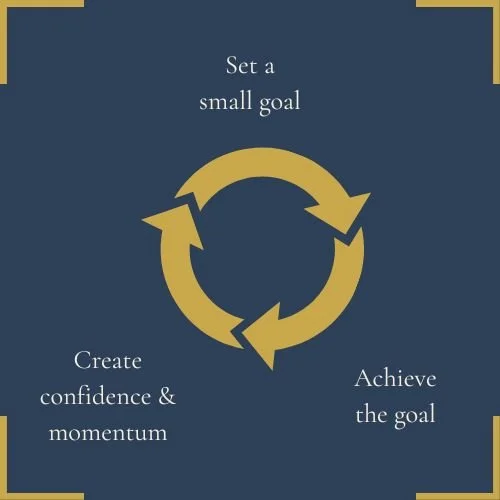
Not only can a small change have a sustainable impact, but it leads to something even more important when it comes to change–confidence.
Let’s say you’ve had a tough week–work was especially stressful, the kids had additional after-school activities, and everything feels chaotic. You wake up on Saturday morning and need to rush out the door, and can’t find your keys. As you run through the house searching, something inside you snaps when you realize how messy everything is, and that the chaos is now impacting your ability to get out the door on time.
“That’s IT”, you think to yourself. “When I get home, I’m cleaning the house”. You start thinking about all the things you need to do. Laundry. Dishes. Dusting. The floors. But in order to do laundry, you need to clean your bedroom. Then you’ll need to wash your bedding. In order to do dishes, you should probably clean out the fridge. Before you can clean the floors, you need to put away all the clutter the kids left everywhere–jackets, shoes, pillows, the puzzle they abandoned in the living room.
Before you even get started, you’re exhausted and overwhelmed. You don’t even know where to begin. You know it all needs to be done, but doing all of it, especially in one afternoon, seems impossible.
Stop. Take a breath.
Pick a room. Look around and decide–which room could I clean that would make the biggest impact on the week ahead? Which room, if it was clean, would save my sanity?
You decide the kitchen would make the biggest difference. Not because it’s the messiest, but because if it was clean, the kids would have a place to sit and do homework, you’d be able to cook dinner with less chaos, and your favorite mug would be clean, which means no struggle to get a cup of coffee on your way out the door on Monday morning.
Then, you decide on one or two tasks to tackle. The refrigerator and the dishes. You spend 15 minutes cleaning out the fridge, and another 30 minutes doing the dishes.
Completing those two tasks can make you feel like you’re gaining control. That can give you confidence. And that can lead to the motivation and momentum that allows you to also wipe down all the counters and sweep the floor.
That confidence can’t be overstated. It’s the point. If we don’t feel like we can accomplish what we set out to do, or if it seems too big, time-consuming, or overwhelming, we may not even start. We’re beaten before we even begin. But if we take the first logical step or two, rather than trying to tackle a whole house, we gain confidence in our own abilities that can motivate us to change or accomplish more.
There’s a free workbook on my website–the One Room Workbook–that addresses this for the different areas of your life. When you’ve addressed one area and one or two goals, you can go back and do it again and again using the same framework.
Some tips for success:
To get the most impact when you set your mini-goals, think about times in your life when you’ve set goals and achieved them. Give yourself a minute to feel what you felt when you accomplished something that made you feel really good. Changing how you feel can be the key to setting yourself up for success.
Think about the outcome rather than the size of the problem. If you can visualize the outcome, clearly and with the emotion (relieved, happy, grateful, etc.), you’re more likely to see it through.
Celebrate your wins, big or small. Often there’s no one there to pat us on the back and tell us we did a good job, so it’s important to do that for ourselves. Reward yourself with something that feels good and is good for you–like a bubble bath, some extra reading time, or even a ten-minute dance session in your clean kitchen.
This concept can be applied to any area of your life that feels overwhelming. Want to lose weight? You can start by setting a step goal or cutting out sugar. Trying to find a new job? Start with jotting down some of the new skills you’ve gained at work in the last year before you even look at your resume. Thinking about starting a business? Make a list of possible business names (as an added bonus, this helps you visualize or imagine the achieved goal).
Let me know your wins for the week, and I’ll celebrate with you and cheer you on!
Always in your corner,